The OA-IA maintains contact with various partners in Switzerland and abroad.
National contacts
In accordance with the Intelligence Service Act, the OA-IA coordinates its activities with the parliamentary oversight bodies and other federal and cantonal oversight authorities. It also engages in dialogue with individuals from the intelligence community and responds to enquiries from members of the public.
Control Delegation (CDel)
In February 2025, the CDel paid an official visit to the OA-IA. During this visit, the OA-IA provided a comprehensive overview of its operational procedures, including the audit cycle and the tools used, and presented two audit reports. The presentation was followed by a valuable discussion on various topics.
The OA-IA submits all its audit reports to the CDel, which decides whether to invite the OA-IA for an additional presentation and discussion of the findings after reviewing the reports. Last year, the OA-IA was invited to present audit reports 22-18 and 24-10 in May, and reports 24-6 and 25-3 in November (these audits are summarised in this annual report).
Federal Administrative Court (FAC)
During the reporting year, representatives of the Federal Administrative Court (FAC) and the OA-IA met on two occasions. The meetings focused on the FAC’s practice in relation to information-gathering activities requiring authorisation and requests concerning cable intelligence. The OA-IA also presented its 2025 audit plan and provided information on current audits. The FAC informed the OA-IA that it had not identified any irregularities in relation to information-gathering activities requiring authorisation, and that requests concerning cable intelligence had been processed within the required timeframe.
Consequently, the discussions mainly concerned operations carried out by the FIS. This enabled the FAC and the OA-IA to cross-check their information. This ensures that information-gathering measures requiring authorisation are comprehensively monitored from the moment they are evaluated prior to approval, until they are assessed upon completion.
Swiss Federal Audit Office (SFAO)
In accordance with the Federal Audit Office Act, the Swiss Federal Audit Office (SFAO) reviews the entire financial budget at every stage of the planning process and carries out random checks before any financial commitments are made. In particular, it examines the management of guarantee credits and internal control systems. Federal administrative units that carry out intelligence activities and are therefore subject to oversight by the OA-IA are also subject to oversight by the SFAO. Close coordination between the two supervisory authorities is therefore important.
Under the terms of the Ordinance on the Supervision of Intelligence Activities (OSIA), the OA-IA and the SFAO may share information relating to their supervisory and audit activities, including their findings, to the extent necessary for the performance of their respective tasks.
In 2025, the two independent supervisory authorities exchanged views on several occasions, both in writing and verbally, regarding general audit planning (annual planning), as well as specific topics and questions related to planned audits. As both authorities were planning audits regarding the CEA, it was necessary to coordinate schedules. Consequently, the OA-IA will not conduct the previously announced audit 25-4 until 2026. The head of the OA-IA has communicated with the relevant SFAO project manager regarding this matter on four separate occasions.
Independent Control Authority for Radio and Cable Communications Intelligence (ICA)
The transfer of the ICA’s activities to the OA-IA, which was planned when the Intelligence Service Act came into force in 2017, is finally set to be implemented with the upcoming amendment to the law. As this will involve dismantling the ICA, knowledge will have to be transferred to the OA-IA in good time. To this end, the ICA president and the head of the OA-IA agreed that an OA-IA representative would attend the ICA’s regular audit meetings in 2025.
The ICA president and OA-IA head also discussed the ICA’s participation in the European Intelligence Oversight Conference, which took place in 2025 in Switzerland, as well as the international contacts of the oversight authorities and the upcoming revision of the Intelligence Service Act.
Federal Data Protection and Information Commissioner (FDPIC)
In autumn 2025, the OA-IA and the FDPIC held a coordination meeting. At the meeting, the OA-IA briefed the FDPIC on the key findings reached in the audits completed by it, as well as those concerning data processing that were ongoing or planned. The discussion also focused on implementing the right of access to information under the Intelligence Service Act.
Cantonal supervisory bodies (KDAO)
In the summer of 2024, the OA-IA began its inspections of the cantons. These inspections continued until the following summer. During this time, discussions were held with the heads and staff members of the respective cantonal intelligence services and the relevant cantonal supervisory bodies. The OA-IA documented the results of these discussions in a report. In audit 25-6, the OA-IA examined specific aspects of cooperation between the CIS and the FIS.
The OA-IA noted that various organisational structures exist with regard to oversight of the CIS in the cantons. For example, responsibility for this task may lie with a police commander, the head of the department responsible for the respective CIS, a representative from another cantonal agency or an independent body. The specific structure depends on the size of the CIS and its background.
The cantons welcomed the visits and appreciated the opportunity to engage in open discussions. The discussions were also valuable for the OA-IA, as they highlighted the wide range of situations, conditions, concerns and approaches within the cantons.
« The OA-IA is therefore planning a conference in 2026 to facilitate this dialogue with cantonal supervisory bodies. »
Specifically, several discussions raised the need for dialogue among cantonal oversight bodies to share experiences concerning supervisory issues and best practices. The OA-IA is therefore planning a conference in 2026 to facilitate this dialogue. Cooperation between the OA-IA and the individual cantonal oversight bodies might also involve, for example, joint audits, support in relation to audit activities or specific sharing of information between the OA-IA and cantonal oversight bodies during the planning and preparatory phase of an audit.
Other meetings
- Head of the DDPS
- Head of the DDPS General Secretariat
- DDPS Intelligence Advisor
- Head of DDPS Internal Revision
- FIS Director (former and new)
- Chief of the Armed Forces
- Chief of Joint Operations Command
- Head of the MIS and AFPPS
- Chief of Cyber Command
- Head of the CEA
- Director of the SFAO
- Head of SFAO Mandates
- fedpol Director
- President of the Conference of Cantonal Justice and Police Directors (CCJPD)
Enquiries from the public
In 2025, the OA-IA received 13 enquiries from the public.
International contacts
The OA-IA exchanges views with oversight authorities from other countries working in the same field, sharing insights on oversight methods, processes and experiences. These exchanges are a constant source of added value for its own oversight activities.
In 2025, the OA-IA participated in three overseas meetings and organised one meeting in Zurich.
European Intelligence Oversight Network (EION) meeting on 22 May 2025 in Brussels
The EION is a network established by the Stiftung Neue Verantwortung in 2018 and renamed ‘interface’ in 2020. It supports and improves the oversight of intelligence services in Europe by providing a platform for sharing ideas between supervisory authorities and experts from other fields, including academia. ‘interface’ addresses issues relating to IT security, data economy, digitalisation and fundamental rights.
The EION workshop in Brussels was attended by representatives from the Council of Europe and eleven countries.
The theme of the workshop was inspired by discussions held at a previous workshop in June 2022. The workshop focused on the risks associated with national security agencies’ disproportionate use of advertising-based intelligence (ADINT).
Its aim was to gather information on this topic from the delegations of the oversight authorities and experts present so that ‘interface’ could draft and publish a report on the matter. The key question was whether oversight bodies have sufficient resources and tools with which to scrutinise the use of commercially sourced data by the intelligence services.
In the paper presented, ‘interface’ proposed an analytical framework describing the various stages involved in accessing and using ADINT data in detail, including a summary of the risks identified at each stage.
The workshop placed particular emphasis on the legal frameworks applicable in the Netherlands, the United States and the United Kingdom, since these countries have introduced new legislation to regulate ADINT.
Intelligence Oversight Working Group (IOWG) Technical Meeting and Staff Meeting from 22 to 23 May 2025 in Copenhagen
Prior to the regular staff meeting, Denmark organised a technical meeting, which was primarily attended by technical experts from the oversight authorities. This relatively new platform has proved its worth and will continue to be used.
The technical meeting was followed by an IOWG staff meeting, which was attended by representatives from Belgium, Denmark, the United Kingdom, the Netherlands, Norway, Sweden and Switzerland. The National Security and Intelligence Review Agency (NSIRA) of Canada also participated as an observer.
In the run-up to the event, each country prepared a presentation based on a set structure covering challenges, solutions and experiences, which it then delivered in the working groups.
The technical meeting focused on questions relating to AI, such as how it can be used or deployed in audit procedures. Other contributions addressed topics such as big data, databases and hacking operations. The OA-IA presented the topic ‘Access to third-party information systems’.
The staff meeting focused on audit methods, necessary skills and knowledge transfer. The OA-IA described its experiences with staff turnover and its approach to recruiting and retaining essential oversight skills.
« The OA-IA gained an insight into the working methods of other authorities, which it can apply to its own further development. »
The open exchange at both meetings proved valuable. The OA-IA gained an insight into the working methods of other authorities, which it can apply to its own further development. It also became clear that all countries are facing similar challenges, particularly with regard to rapid geopolitical and technological change and the ongoing need to ensure that staff have the necessary audit skills.
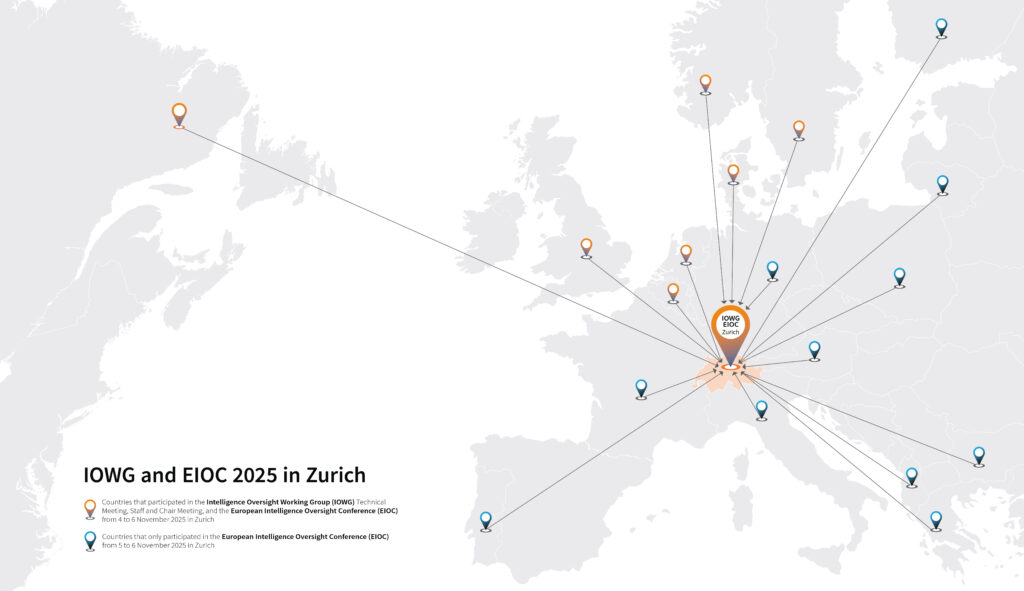
Intelligence Oversight Working Group (IOWG) Technical Meeting, Staff and Chair Meeting, from 4 to 5 November 2025 in Zurich
From 4 to 5 November 2025, the OA-IA hosted a series of meetings for members of the IOWG. At one of these meetings, the heads of the various participating oversight authorities formally admitted the Canadian oversight authority, which had held observer status since November 2023, as a member of the working group. Participants outlined the oversight situation in their respective countries and expressed particular interest in the potential impact of their audits on audited entities and how this should be reported. The working group’s discussions at the staff and technical meetings focused on the challenges in accessing information from audited entities and the need for enhanced cooperation. Participants also had the opportunity to share their experiences of the technical aspects of audits, particularly with regard to cryptocurrencies.
European Intelligence Oversight Conference (EIOC) from 5 to 6 November 2025 in Zurich
The EIOC took place in Zurich from 5 to 6 November 2025. Presentations were given by the intelligence oversight authorities of Switzerland, Lithuania and Canada on various topics, including oversight risk management, the challenges involved in setting up their units, and specific issues arising in relation to their organisational structures. On the second day, the focus shifted to AI in a supervisory context, particularly the legal challenges associated with intelligence services collecting mass communications data. The SFAO presented the latest AI developments, explaining the dual challenge these new technologies pose to both the oversight authorities and audited entities. These topics were then discussed in a panel session with representatives from the Norwegian and UK oversight authorities. At the same time, experts presented an overview of the situation regarding the collection of mass communications data in Switzerland and Germany. A subsequent panel discussion on this topic enabled a comparison of state practices, including those of France. At the end of the event, the FIS commented on the influence of oversight on the organisation.
Representatives from the OA-IA were present, as were delegates from Belgium, Bulgaria, Denmark, Germany, Finland, France, Greece, the United Kingdom, Italy, Canada, Lithuania, the Netherlands, Norway, Austria, Portugal and Sweden. The SFAO, ICA, FDPIC, FCA and the CDel Secretariat also attended the meeting.